Post-Surgery Drainage And Fibrosis Prevention
FOR LICENSED HEALTHCARE PROFESSIONALS - NOT FOR COSMETOLOGISTS OR ESTHETICIANS
Course Overview
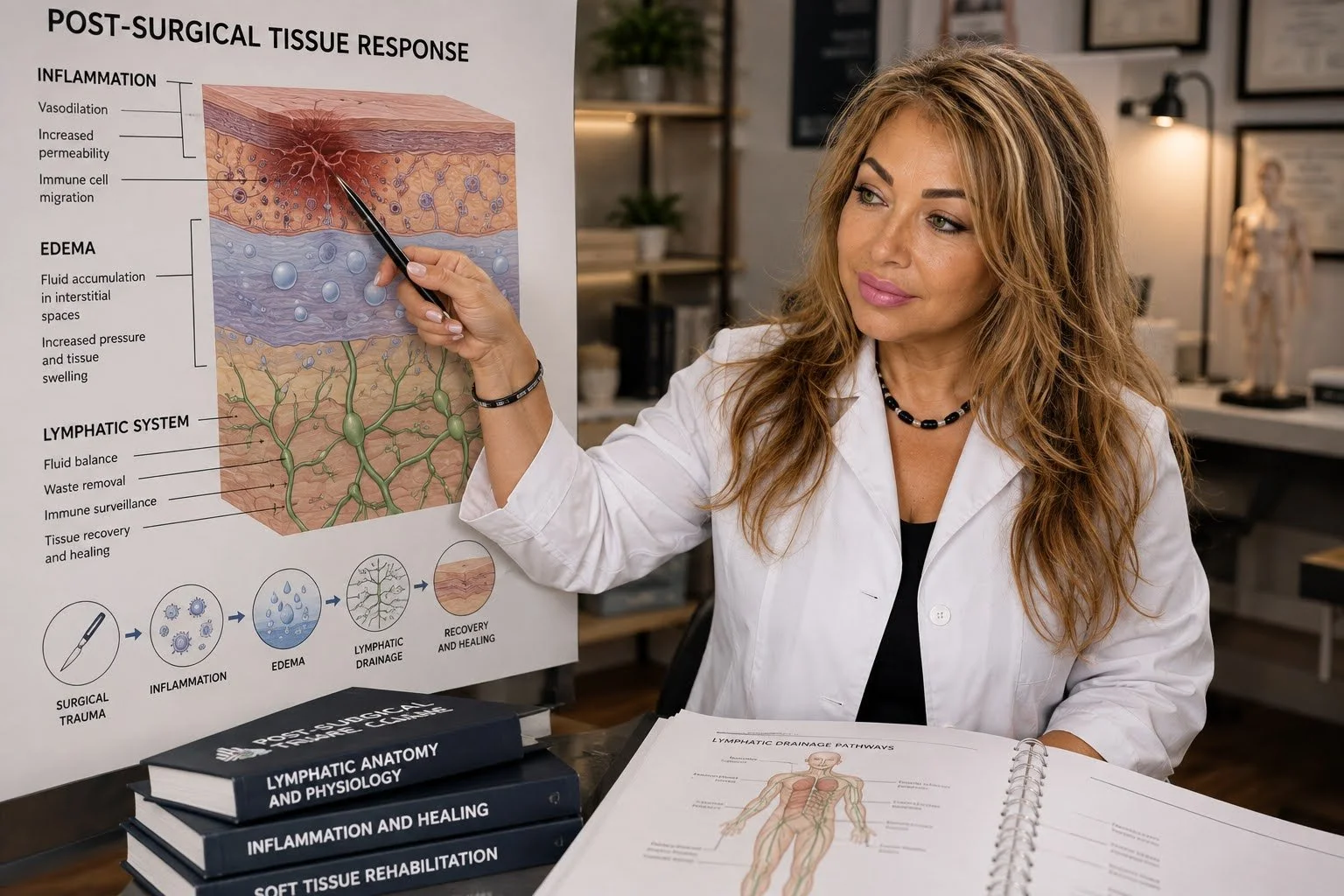
Post-Surgery Drainage and Fibrosis Prevention provides specialized education for licensed healthcare professionals caring for patients after plastic surgery. The course covers post-surgical tissue response, lymphatic drainage, treatment timing, professional safety considerations, and the principles of fibrosis prevention.
Through structured academic content and real-patient clinical demonstrations, students develop a stronger foundation for making informed treatment decisions while respecting professional scope of practice and the condition of healing tissue.
Who is this for
Professional education for licensed healthcare professionals
This course is designed for licensed healthcare professionals — including LMTs, PTs, nurses, kinesiologists, and other credentialed practitioners working in post-surgical or rehabilitative settings.
Courses are provided for educational and professional development purposes only. They do not grant professional licensure, expand scope of practice, or authorize restricted procedures.
Professional credential verification is required before enrollment.
WHY SPECIALIZED TRAINING MATTERS
Post-surgical tissue is not healthy, untreated tissue.
Post-surgical tissue is inflamed, fragile, and actively repairing. When it is treated incorrectly, the consequences may extend beyond ineffective treatment and contribute to complications such as seromas, indentation, and fibrosis.
Patients are still treated by providers without the professional preparation or specialized training needed to work with post-surgical tissue—and the resulting damage may not become evident until it is difficult to correct.
Post-surgical treatment is a clinical specialization, not an add-on service.
If you are a licensed professional ready to treat it as one, this training was developed for you.
WHAT YOU’LL LEARN
Build the clinical foundation behind safer, more informed post-surgery treatments.
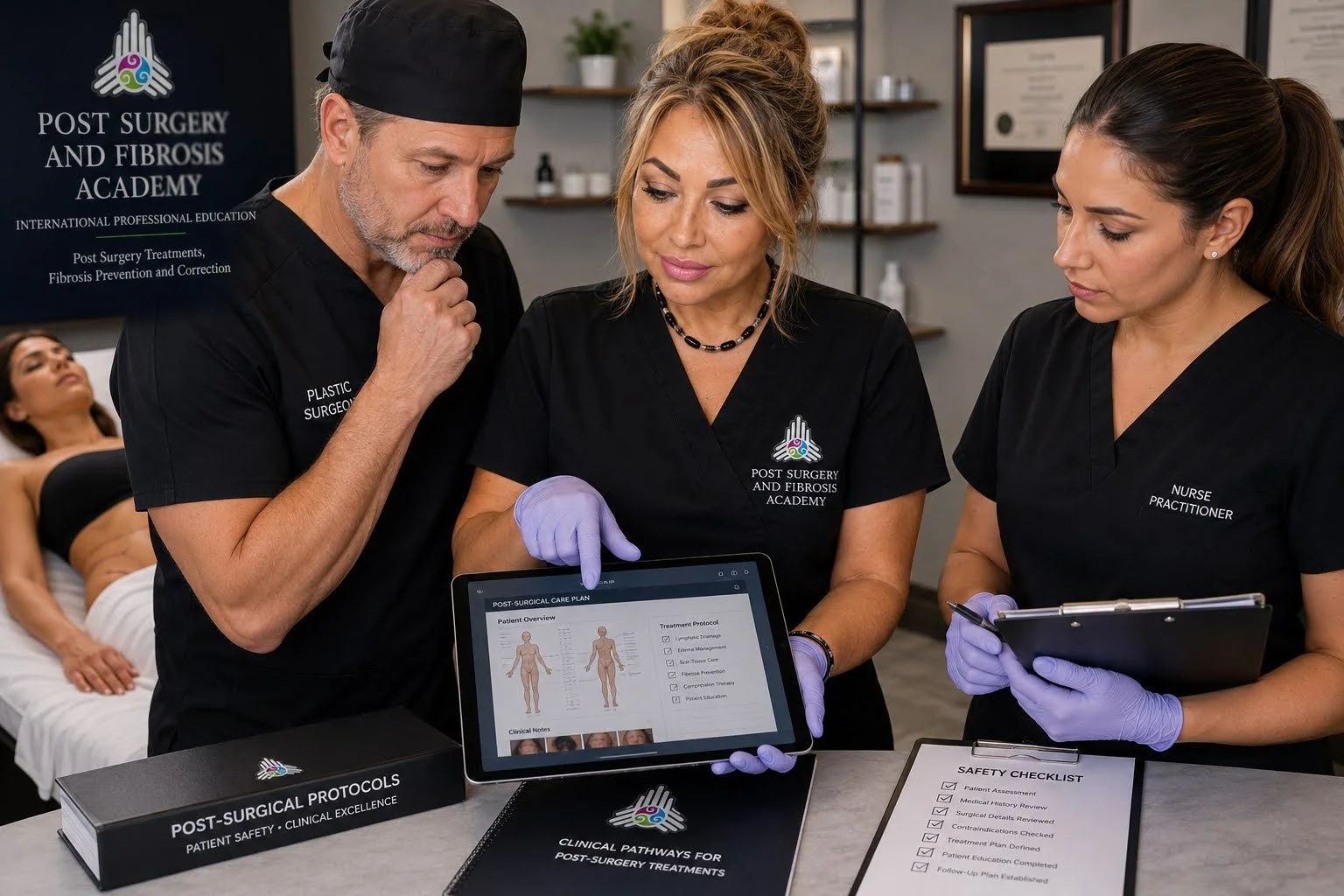
This course goes beyond learning a sequence of techniques. Students develop the knowledge and clinical reasoning needed to understand post-surgical tissue, recognize risk, make appropriate treatment decisions, and apply manual techniques with greater purpose and professional responsibility.
-
POST-SURGICAL TISSUE & HEALING
Understand inflammation, edema, lymphatic response, tissue repair, and the biological changes that occur as the body moves through recovery.
-
CLINICAL REASONING & SAFETY
Learn to evaluate tissue condition, recognize indications and contraindications, identify risk, and make treatment decisions based on what the tissue presents—not simply on the number of days since surgery.
-
MANUAL LYMPHATIC DRAINAGE AFTER SURGERY
Understand the role of Manual Lymphatic Drainage after plastic surgery, including pressure, direction, rhythm, lymphatic pathways, and the principles that guide its safe application.
-
FIBROSIS PREVENTION & PROFESSIONAL RESPONSIBILITY
Explore the factors that can contribute to abnormal post-surgical tissue response and fibrosis, while learning what professionals can do—and what they should avoid—to support recovery within their professional scope.
See What’s Inside the Course
Explore the six modules, structured chapters and lessons, knowledge checks, and real-patient clinical training included in the program.
POST-SURGERY DRAINAGE AND FIBROSIS PREVENTION
The course includes 6 comprehensive modules with structured chapters and lessons, plus 11 real-patient clinical training videos demonstrating post-surgical care and manual lymphatic drainage techniques.
For the full curriculum, expand each of the modules on the right (+)
-
Chapter 1 — Legal Framework of Postoperative Care in Florida
Lesson 1.1 — Legal Framework of Postoperative Care in Florida
Lesson 1.2 — Professional Boundaries, Scope and Responsibility
Lesson 1.3 — Therapeutic Massage, Medical Massage and Professional Boundaries
Chapter 2 — Who This Course Is For — and Who It Is Not
Lesson 2.1 — Who This Course Is For — and Who It Is Not For
Lesson 2.2 — Nurses and Massage Therapists as Postoperative Providers
Lesson 2.3 — Estheticians and Aestheticians: Semantic, Legal, and Clinical Confusion
Lesson 2.4 — Physical Therapy and Dermato-Functional Kinesiology
Lesson 2.5 — Postoperative Care as Rehabilitation: Between Marketing and Clinic
Module 1 — Knowledge Check
-
Chapter 3 — The Role of the Trained Professional in Postoperative Care
Lesson 3.1 — The Role of the Trained Professional in Postoperative Care
Lesson 3.2 — Massage, Manual Therapy, and Professional Distinctions
Lesson 3.3 — Lymphatic Drainage as Manual Therapy, Not Massage
Lesson 3.4 — Post-Operative Care as a Therapeutic Act, Not an Aesthetic One
Lesson 3.5 — A Structural Gap That Harms Patients
Chapter 4 — What Post-Operative Care Is — and What It Is Not
Lesson 4.1 — What Post-Operative Care Is — and What It Is Not
Lesson 4.2 — Healthy Tissue vs. Post-Surgical Tissue
Lesson 4.3 — The body after surgery
Lesson 4.4 — Post-Surgical Tissue and Its Biological Response
Lesson 4.5 — Internal scarring and the need for a different approach
Module 2 — Knowledge Check
-
MODULE 3 — Overview & Learning Objectives
Chapter 5 — Post-Surgical Tissue and Its Biological Response
Chapter 6 — Surgical Trauma: A Starting Point, Not a Destination
Module 3 — Knowledge Check
-
Chapter 7 — Part One: Foundations, Indications, and Contraindications
Chapter 7 — Part Two: Documentation and Patient Intake for Post-Surgical Treatment
Chapter 7 — Part Three: Manual Lymphatic Drainage Technique
Chapter 7 — Part Four: Approved Manual Lymphatic Drainage Sequence
Chapter 7 — Part Five: Compression Garments and Accessories
Chapter 8 — Part one: When Surgery Ends, but the Risk Is Just Beginning
Chapter 8 — Part two: When the remedy becomes harm
Module 4 — Knowledge Check
-
Module 5 — Overview & Learning Objectives
Chapter 9 — Emotional and Psychological Impact
Chapter 10 — Considering a Revision Surgery
Module 5 — Knowledge Check
-
Module 6 — Overview & Learning Objectives
Chapter 11 — Fibrosis Prevention
Chapter 12 — Manual Lymphatic Drainage, Prevention, and Professional Responsibility
Module 6 — Knowledge Check
-
Treatment Table Setup & Patient Positioning After BBL Surgery
Full-Body Manual Lymphatic Drainage — Vodder Method After Liposuction
Manual Lymphatic Drainage After Neck Liposuction & Chin Fat Transfer — Part 1
Manual Lymphatic Drainage After Neck Liposuction & Chin Fat Transfer — Part 2
Post-Liposuction Torso — Posterior Torso & Back
Post-Liposuction Torso — Lateral Torso & Flank
Manual Lymphatic Drainage After Breast Surgery
Axillary Lymph Node Stimulation After Breast Surgery
Pectoralis Muscle Release After Breast Surgery
Manual Lymphatic Drainage — Upper & Lower Extremities
MLD Hand Technique — Direction, Pressure & Pumping Movement
COURSE FORMAT
Professional Training Designed for Practical Application
The course is organized to guide students from foundational knowledge to clinical application through structured lessons, knowledge checks, and real-patient demonstrations.
-
6 Modules
Structured chapters and lessons presented in a progressive learning sequence.
-
Knowledge Checks
Short assessments throughout the course help reinforce key concepts and professional decision-making.
-
11 Clinical Demonstrations
Real-patient training videos provide practical examples of post-surgical treatment principles and techniques.
-
Online Professional Training
Course access is provided after professional credential verification, approval, and enrollment.
Course hours and Continuing Education information will be displayed when officially applicable.
PRICING & ENROLLMENT
Invest in Specialized Professional Training
Post-Surgery Drainage and Fibrosis Prevention
Course Tuition Fee: $1,990
Introductory price valid until October 31, 2026. Regular price: $ 2,500
Your enrollment includes access to the complete course program, required knowledge checks and assessments, real-patient clinical demonstrations, and the educational materials included with this course.
Students receive 90 days of course access from the enrollment date.
We issue a Certificate of Completion after you successfully complete all applicable course requirements.
Professional credential verification is required before enrollment.
Continuing Education credit and applicable CE information will be displayed only when officially approved for this course.